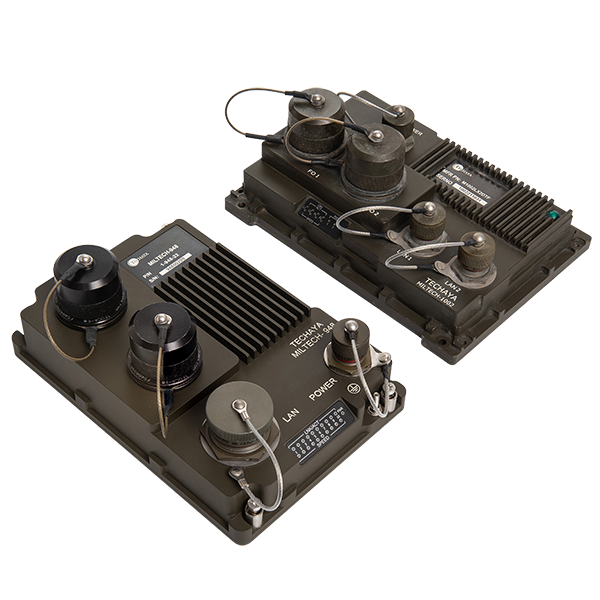
Media Converters

For all your requirements, we’ll custom design a solution to fit your needs
CONTACT US TODAYYes. They are orderable as non-PoE, as a Powered Device (PD) that draws power from the network, or as Power Sourcing Equipment (PSE) that feeds downstream devices, with support for 802.3af, 802.3at, and 802.3bt including higher-wattage budgets. This lets one unit power a camera or radio in the field without a separate supply. Confirm the PoE budget and standard on the specific datasheet, since it differs between the PD, PSE, and non-PoE variants.
Serial ports across the line handle RS232, RS422 (full duplex), and RS485 (half or full duplex depending on the unit), including RTS and CTS handshaking. Some units expose these as multiprotocol ports, while others ship in a fixed configuration set by the part number. Check the physical ports section of the datasheet to see whether a given port is switchable or fixed and request the ICD from the factory for signal-level pinout details.
Yes, several products are built for this. The serial and I/O terminal servers can run in a back-to-back bridge mode over Ethernet so serial and discrete signals appear transparently at the far end, and the fiber communication system transfers video, serial, discrete I/O, and Gigabit Ethernet over a single tactical fiber between a transmitter and receiver. Serial-over-USB units can also cascade multiple devices to expand port density on one host. The datasheet for each product describes the supported topology and any pairing requirements.
It depends on the product. The media converters are generally unmanaged with DIP-switch settings for auto-negotiation, speed, and features like fiber-loss link shutdown or port segregation, plus optional remote management. The fiber communication system includes a fully managed SNMP and CLI Gigabit Ethernet switch, and the terminal servers allow fixed IP and per-port assignment. Check the networking section of the specific datasheet to confirm the management model.

|
Bel Aerospace & Defense P: +49 4261 9429979 Sales office: Amelia-Mary-Earhart-Str. 8 This email address is being protected from spambots. You need JavaScript enabled to view it.
|